The Turtle Creek Special Assessment That Shows What Texas Condo Law Doesn't Require
September 17, 2026
September 17, 2026
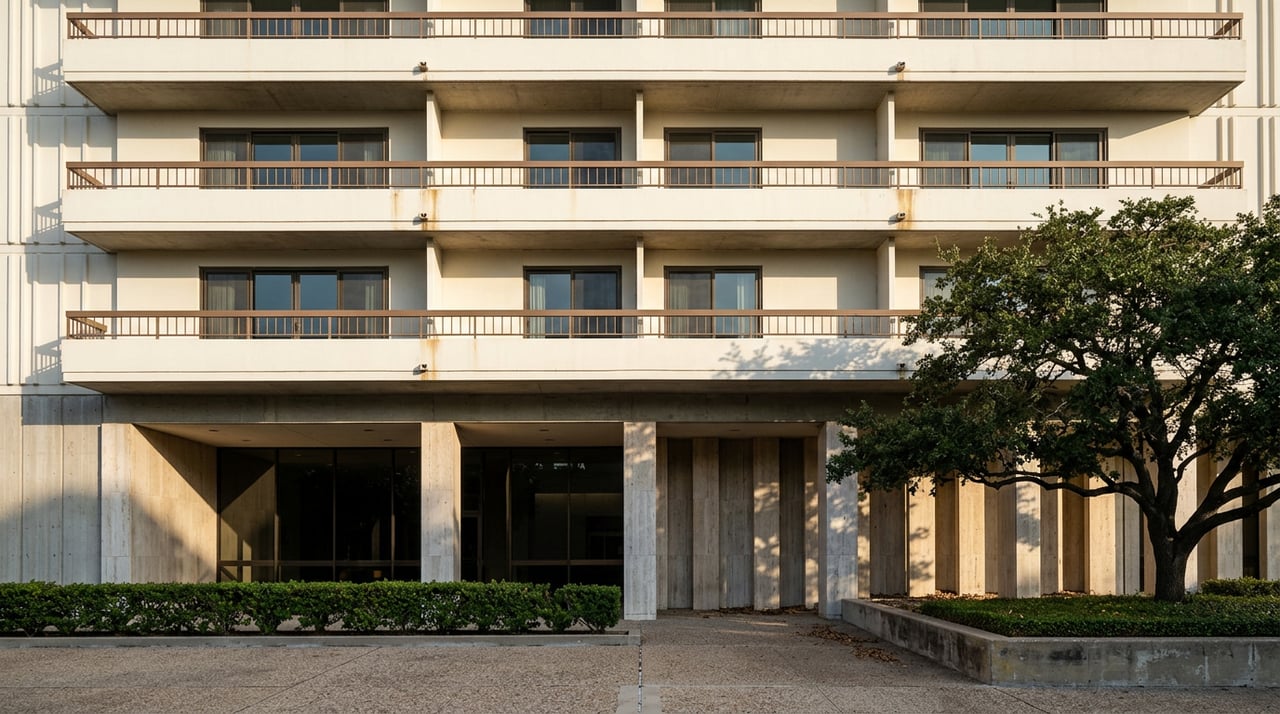
The board at Twenty-One Turtle Creek spent the first part of this decade doing everything right. After bringing in Action Property Management in 2022 under new board president David Curry, the building renegotiated four outside service contracts and saved more than $50,000. It completed a balcony repair project. It repainted the common areas. Then it got to the underground parking garage, and the number stopped being a rounding error. The garage work is a critical step in preserving the building's structural integrity, significant enough in cost that the board is now arranging financing so owners who can't write a check for their share of a special assessment don't have to.
Nothing about this is unusual for a 1963 tower that spent sixteen years as an apartment building before converting to condos in 1979. Buildings that age eventually need garage decks, elevator cabs, and facade systems replaced. What's worth pausing on is what happens between the day a board realizes the work is coming and the day a buyer signs a contract on a unit in that same building. In Texas, almost nothing has to happen. And that gap is the thing every Turtle Creek condo shopper should understand before they waive an option period.
Ask a buyer's agent in California or Florida what a reserve study is and they'll pull one up from a filing cabinet, because their state requires one. Florida mandates a Structural Integrity Reserve Study for any condo building three stories or taller, a law written directly in response to the 2021 Champlain Towers South collapse and tightened twice since. Colorado passed its own reserve study mandate in 2022. Texas has done neither. The Texas Uniform Condominium Act, which governs condos under Chapter 82 of the Property Code, lets a board budget for reserves and lets a board fund them, but it never requires a board to commission a study or hold a minimum balance. Neither does the statute covering non-condo HOAs. The declaration and the board's own judgment carry the entire weight.
That's not a loophole so much as a design choice, and it means the age of the building tells you more than the state of its finances. A tower built in the 1960s or 70s can be immaculately reserved if its board has been disciplined for decades, or it can be one bad winter away from a five-figure bill per owner, and there is no state filing that will tell you which one you're looking at from the outside. The only place that information legally has to surface is a single document, produced at a single moment in the transaction: the resale certificate.
Section 82.157 of the Property Code obligates every condo association to produce a resale certificate on request, and it has to arrive within ten days. It also has to contain specific line items, not a general summary.
| What the certificate must disclose | What it actually tells a buyer |
|---|---|
| Frequency and amount of regular assessments | Whether monthly dues have kept pace with the building's age and systems |
| Approved special assessments not yet due | Whether a bill like the garage project at Twenty-One Turtle Creek is already on the books before you close |
| Amount of reserves for capital expenditures | Whether the association has money set aside, or whether the next repair becomes a special assessment by default |
| Capital expenditures approved for the current fiscal year | What the board already knows is coming, in dollar terms |
| Total amounts due and unpaid on the unit | Whether the seller is current, since unpaid dues can attach to the property |
| Certificate of insurance for common areas | Whether the master policy is active and adequate |
| Pending lawsuits and unsatisfied judgments | Whether the association is carrying legal exposure that could turn into a future assessment |
None of this requires a reserve study to exist. A building with no study at all still has to answer the reserve-balance question on the certificate, and a board with nothing set aside has to write that down in black and white. The certificate is the leverage point, not the study, because the study is optional in Texas and the certificate is not.
One thing did shift recently. Senate Bill 711, passed by the 89th Texas Legislature and effective in September 2025, capped what an association can charge to prepare that resale certificate at $375. Before that, the fee was uncapped, and it wasn't unusual for owners or buyers to be quoted several hundred dollars with no ceiling in sight. The cap doesn't change what has to be disclosed. It changes the cost of asking. For a buyer trying to get a clean read on a building before the option period runs out, that's a small but real improvement, because a $375 ceiling makes it easier to justify requesting the certificate early rather than waiting to see if the seller's disclosures raise a flag first.
What hasn't changed is the timing risk. A ten-day delivery window sounds generous until it collides with a typical Texas option period, which often runs shorter than that. Request the certificate the day the contract is executed, not after the inspection comes back clean, because the document that actually tells you about assessment risk moves on its own calendar.
The math on why this matters is straightforward once you see it. Special assessments in Dallas-area high-rises fifteen years or older tend to show up for the same handful of reasons: elevator modernization, facade repair, plumbing risers, and parking garage structural work. Projects like these commonly run from several hundred thousand dollars into the low millions per building, and divided across a hundred or so units, an individual owner's share can land anywhere from ten thousand to fifty thousand dollars or more. That's the number the resale certificate is trying to warn you about, if you know to read the reserve-balance line against the building's age.
This is also where the corridor's older addresses and its newest one tell two different stories. A tower like Twenty-One Turtle Creek, or the mid-century high-rise at 3525 Turtle Creek known simply as "3525," carries decades of deferred-maintenance history that shows up somewhere in board minutes and reserve figures, for better or worse. Rosewood Residencies Turtle Creek, the 17-story tower at 3555 Dickason Avenue that topped out in 2025 with construction targeted to wrap by late summer 2026, carries none of that history yet, for the simple reason that it doesn't have any. New construction trades assessment risk for a different unknown: no track record at all for how disciplined the board will be once the building starts aging. Neither position is automatically safer. Both are things a buyer can only evaluate by asking the right question of the right document, not by assuming a newer building is a cleaner one.
Monthly dues are a related but separate signal, and it's worth not conflating the two. Turtle Creek's older, full-service towers commonly run $800 to $2,500 a month in HOA fees, well above the $500 to $1,000 typical of newer Uptown mid-rises, largely because those fees are paying for concierge staff, valet, and larger common-area footprints, not necessarily because reserves are healthier. A high monthly fee tells you what the building is staffed like. It does not tell you what's in the bank for the next capital project. Only the resale certificate does that.
None of this requires distrust of any particular building. It requires knowing that Texas puts the burden of finding out on the buyer, on purpose, and that the tool for finding out already exists and now costs less to use than it did a year ago.
If you're comparing specific addresses along the boulevard, from the established towers to newer construction like Rosewood Residencies, Anthony Cedano can walk through what a given building's resale certificate and reserve position actually mean for your offer. Explore more on Turtle Creek real estate, read the full buyer's guide to Turtle Creek high-rise condos, or request a complimentary home valuation or market consultation before you go under contract.
Does Texas require condo associations to get a reserve study? No. Chapter 82 of the Property Code lets associations budget for reserves but doesn't require a study or a minimum funded balance. Any study requirement has to come from the building's own governing documents.
How much can a Texas condo association charge for a resale certificate? Up to $375, under a cap the Legislature added through Senate Bill 711, effective September 2025. Before that, the fee was uncapped.
What's the difference between HOA dues and a special assessment? Dues are the recurring monthly charge that funds routine operations and whatever reserves the board chooses to set aside. A special assessment is a one-time charge, often tied to a specific capital project like a garage or elevator, levied when reserves aren't enough to cover it.
Stay up to date on the latest real estate trends.
Get assistance in determining current property value, crafting a competitive offer, writing and negotiating a contract, and much more. Let me guide you through your home-buying journey.

ANTHONY CEDANO
5950 BERKSHIRE LN STE 100 DALLAS TX 75225